
Lyndsie Manusos
Exempt Burning Activities and Required Conditions
When she was twenty-four years old, Grandma Pink Harrison flung a flaming mattress out the window while pregnant. She used to own a small resort on the Chain O’ Lakes in northwest Illinois. She called it While Away and proudly kept it spotless.
On a morning round, she checked one of the cottages and saw the mattress aflame. Either from a cigarette or pipe. Rather than lose the cottage, she hoisted the mattress onto her shoulders and shoved it through the window.
The mattress became a bonfire; the grass never grew back where it burned. She went into labor not long after and claimed that residents of her resort could hear her screams as she pushed our mother into the world.
Ceremonial Fires Are Allowed Per Local Ordinance
Grandma liked to tell that story to us over and over again, molding herself into some sort of myth, chucking a great evil from her shoulders. She whispered my sister and I should be so lucky to be twinkles.
You were twin stars even before your mother was born.
We had giggled then, feeling our first dose.
The scorch of such love.
Burnings Cannot Be Used for Disposal Purposes
After Grandma Pink passed away just after our eleventh birthdays, our mother inherited the now-crumbling resort. She’d not wanted it, had begged Grandma not to leave the “old village,” as she called it, to her. She wanted Grandma to sell the land, but Pink couldn’t do it. She didn’t have the heart.
We had sat in a waiting room while the will was read, and we heard Mom shriek with rage from the down the hall. While Away was in her name.
Mom left home on a windy night a week later. She returned soaked in gasoline and smoke. She called it a cleansing. Hoisting the great burden from her shoulders. She was nothing like the legend of our Grandma Pink. She was also exactly like her.
Mom had burned the cottages. Every single one.
The next morning, she drove us to the property. The police arrived on account of the unauthorized burn. Mother stood proudly against the onslaught of smoke and officers, who asked her, “Was it you?”
Only Burn One Pile At A Time
Mom stared at us through the car windows as we waited in the backseat of her sedan. In the car it reeked of smoke, burning our eyes. Making us cry.
Even now, we remember red lights and naked ground. Scalded.
We held hands, twin stars, and through the smoke, swore we saw a figure carrying something large upon their shoulders. The shadow moved toward the lake’s edge, stood on the stone seawall. Hoisting that great weight.
Away, away, away.
Our mother told the cops she’d burned down the cottages, but they shook their heads, saying neighbors near the resort saw someone else on the grounds.
“No,” our mother insisted. “It was all me.”
All the while, we watched the shadow return to each scalded spot. There and back again to the sea wall. As if Grandma Pink’s ghost planned to hurl a dozen mattresses into the squall.
Craft Essay: “Energy in Editing”
Much of my editing, going from one draft to the next, has to do with adding momentum to the story. In the past, as a flash editor for JMWW or as a slush reader of literary magazines, such as The Missouri Review and The Masters Review, I often looked for momentum in a submission. Even successful quiet stories, even stories we call “cozy,” have a movement to them, an energy that inspires us as the reader to continue reading. We hear a lot these days, especially on social media, about the “vibes” of books, about the vibes being more important than the plot. And then dear Edna O’Brien told The Paris Review to “fuck the plot!” So, of course, there are many preferences of what readers want in a good story, and a multitude of factors that make a successful story. Overall, though, I’d argue we’re looking for something similar: momentum.
We’re looking for that energy.
Award-winning author Charlie Jane Anders wrote in Never Say You Can’t Survive: How to Get Through Hard Times by Making Up Stories (indeed, an apt book for the times we’re living in), “I found that the more a of a situation I could cram into those opening words, the greater the sense of momentum I could create, that could carry me through the rest of the story.” I love this quote because it captures what I’ve noted about my editing preferences, how easy the editing is if I have that strong situation at the beginning and further honing that momentum to get through the rest of the story.
My initial draft of “Ceremonials” was a micro story “While Away,” and it was not meant to be a micro story; in hindsight, I realized it merely didn’t have enough momentum to be a longer story. By adding the structure of the rules of acceptable public burnings and ceremonial burnings, it not only added a layer but energy. If you look at my past work, you’ll see it’s a tool I use often–adding a structure of titles—to give the momentum, that energy, what a story needs.
Draft: “While Away”
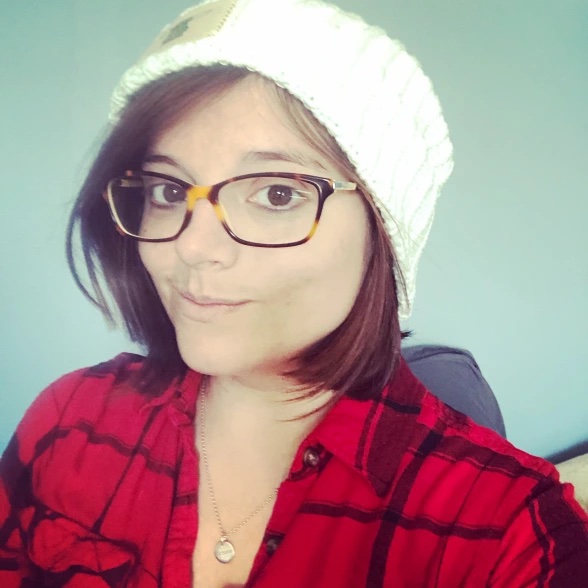
Lyndsie Manusos’s work has appeared in Barrelhouse, SmokeLong Quarterly, The Magazine of Fantasy & Science Fiction, and other publications. Her work has been twice nominated for a Pushcart, and her short story, “She Builds Quick Machines,” was featured in the LeVar Burton Reads Podcast. Her debut novella, From These Dark Abodes, was published in Fall 2024. You can read more of her work at lyndsiemanusos.com.
 faircopyjournal.com